Sunday, March 29, 2015

More School Make/Innovation Spaces

In late October, 2013, I visited several makerspaces in the bay area crammed into one day, and blogged about my discoveries here.

Then, in summer 2014, I visited two more makerspaces and blogged about those here.

Most recently, the fabulous Jaymes Dec hosted me at Marymount in NYC, Kat Sauter hosted me at Ann Richards STARS in Austin (whom I also visited back in 2013 before their makerspace!), and Ross Monroe hosted me at Edmonds Community College right here in Seattle.

(This great post by the Tarrant Institute for Innovative Education at the University of Vermont also has some great ideas and examples for flexible physical learning environments.)

Again keeping the same structure as my previous posts, with one additon:

Overall Organization
Safety (new)
Furniture
Student Projects
Fun Toys


Overall Organization


Marymount's "makerspace" was actually significantly distributed throughout the school, with elements in the high school, middle school, and primary spaces. "Making" is well on it's way to being simply fully integrated into the subject area classes at Marymount, and it shows.

Ann Richards and ECC both have clearly designated makerspaces, with Ann Richards' more clearly matching much of the layout I've seen at other schools and ECC's much closer to a traditional machine shop with some awesome new elements (3D printing).

Pegboards and clear bins were particularly prevalent, as I've often found. We're leaning very heavily towards the pegboard-with-sharpie-outlines model of tool storage, hoping for very easy cleanup even for our pre-reader little makers.

Marymount's bins and pegboard
One thing I particularly like about Jaymes's bins at Marymount is the organization according to type of activity... Rather than "electronics" and "sewing," Jaymes has his shelves arranged by "Invent Something" or "Prototype Something."


Ann Richards' pegboards

ECC's pegboard specifically for cardboard cutters. I'm totally getting some of these.


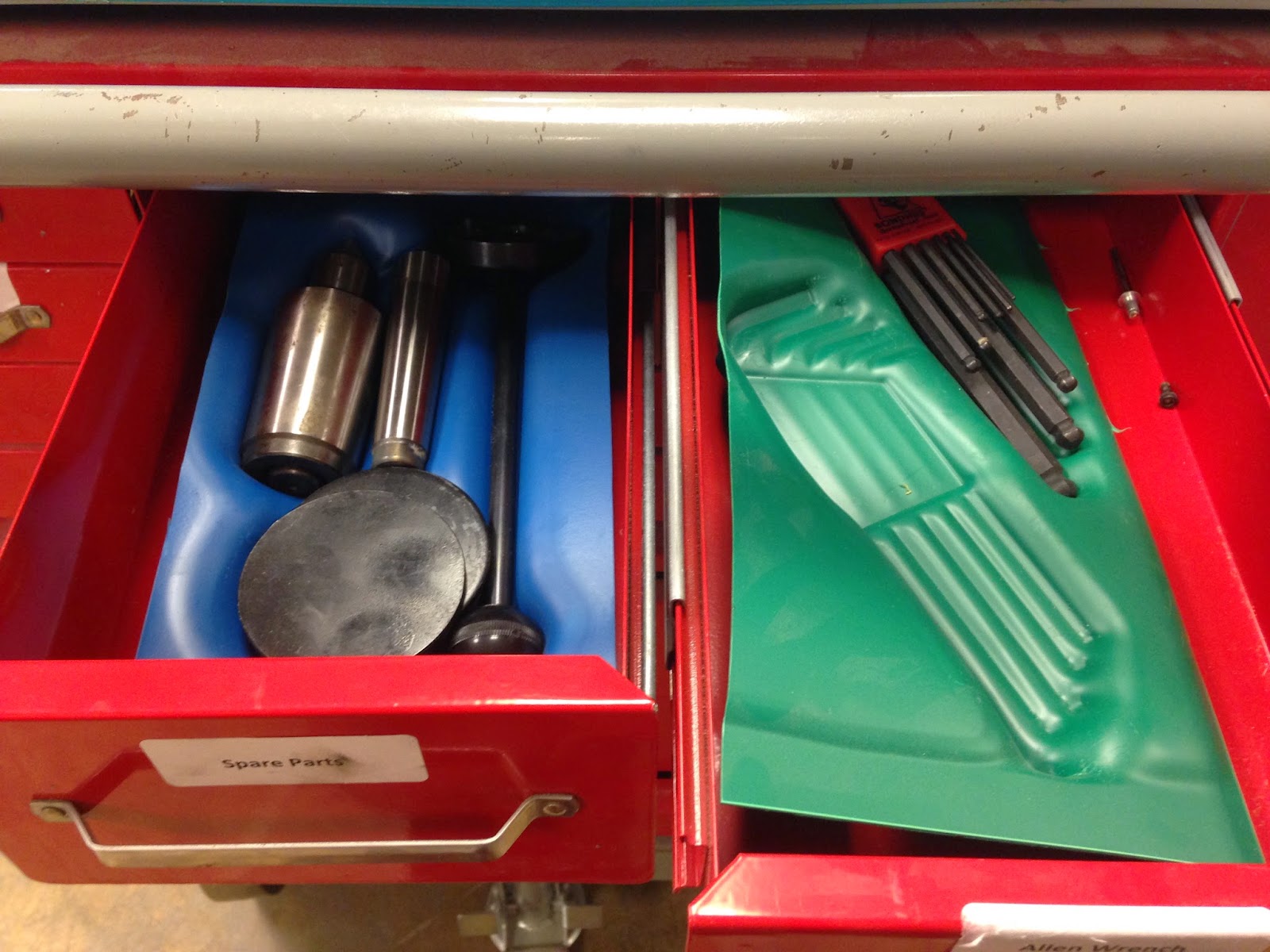
ECC also had some very heavy-duty rolling tool chests, and they used their vacuum former to create custom trays for their different tools. They also used both photos and text labels, resulting in some of the same visual organization that clear bins offers.


Ann Richards was the only school with a brainstorming space within the makerspace itself. It was a spot of color and comfyness in the otherwise industrial space. We're planning to have a small cafe/library space for brainstorming and reading idea books, and this is a nice model.


Another great element from Ann Richards was their homemade drill and glue gun organization systems. I've been wanting some sort of glue gun rack for several years now, and am fully planning to steal this idea the second our laser cutter is set up.


Kat was much less excited about her in-progress student project organization... This is not far from my student project organization system in my science classroom right now, and I definitely don't recommend it.  Perhaps a different style of bins, to differentiate from materials and allow students to keep their pieces contained?


Safety


I can't believe I haven't had a dedicated section for this before... I was really impressed with the safety structures in place at Ann Richards. They have hearing protection prominently displayed with other tools, student-created safety signs like the "Sharp Object Protection" example here, and - my favorite - simple graphics accompanying each piece of equipment to show what you need to be able to operate that tool: eye, ear, and/or pony.


Furniture


The piece of furniture I was most excited about was the sound booth at Marymount. My students are constantly complaining about the difficulty of creating audio recordings - for videos, for animations, for podcasts, for world language assignments - and this simple booth would get heavy use... We're currently planning to buy/build two for our Lab.


In general, both Ann Richards and Marymount have heavy wood lab benches with some storage underneath, and basic metal stools. ECC uses their rolling tool chests also as workbenches, and has no stools - since their actual work spaces are separate, they find no need for seating.

Ann Richards' main space.


Student Projects


Marymount had some really wonderful student projects on display, including a functional 3D-printed robot that a high school engineering class was working on, recycled fashion, robots programmed to perform a ballet, and a challenge project resulting in prosthetic hands able to hold and tilt a can of soda.


Ann Richards didn't have very many projects on display, but several examples of neat signage made by the students. Kat commented that a couple of the signs were made with inappropriate materials, like the very nice particleboard for the JUSTICE sign when cardboard would have done just fine. I anticipate that being a challenge for us as well... Already, my students use leather sheers to cut cardboard and wire strippers to cut chicken wire. *sigh* More training will help.


Ann Richards' truly spectacular project, however, is their Project Ventura camping trailer renovation, a multi-year project undertaken by several different classes every year. I have just a few pictures here, but visit their blog for more details.


(a photo of a "before" image displayed in the trailer, and an actual photo of the same spot at the time of my visit)


I really only have one project from ECC to show: this vacuum-formed podium. I expressed some skepticism that a vacuum former is a really useful tool, and Ross and his lab manager Justin jumped to show me some examples. Their students regularly use their CNC mill to cut foam into the desired shape, vacuum form a mold from the foam, then use the vacuum-formed mold to make the final product out of plastics, concrete, or whatever material. I'm sort of convinced... I think our admissions and development offices would REALLY enjoy making some custom-molded chocolates for school events.


Fun Toys


3D printers:
- The MakerBot Replicator 2 had a pretty poor review, especially that the cartridge clogged often.
- The Lulzbot TAZ got a good review... easier and more reliable than the MakerBot. However, the guys at ECC pointed out that the TAZ software is pretty non-friendly and doesn't automate scaffolding.
- The Polar3D is brand-new, so they haven't used it yet... But a new style of 3D printer with a rotary plate (a "polar coordinate" printer)
- The uPrint got a great review, but far too expensive for our needs
- The Formlabs got probably the best review of all of them, with high reliability and friendly software where you can even adjust the supports.


Kat keeps a quick model of different printing densities next to their TAZ for reference:


CNC routers:
The gigantic CNC router at ECC is a heavily-used tool, and a very large tool. Marymount barely uses their CNC, but when it works, it can make some neat products like the custom-etched hair bow below. Ann Richards had *just* set up their CNC when we visited, and hadn't used it yet.

Marymount's mini CNC

ECC's maxi CNC

Laser Cutters:
Both Marymount and Ann Richards have the universal Epilog cutter, but ECC has a Universal laser cutter, which I'd never seen before (I'm going to go ahead and leave that poor wording, because I think it's funny). The pros that Ross and Justin shared with us for their Universal are 1) multiple laser heads for different energy needs, and a much wider and feed-through bed for very large cuts.


Other little things:
I've always been sort of skeptical of conductive fabric, but Jaymes has this very cute technique for using conductive fabric to create a battery-holder pocket.


ECC has pneumatic orbital sanders, and the full compressed-air system throughout their space to run them... They feel strongly that an compressed-air system is a vital component of a makerspace, but I'm still not sure... I see the value of both pneumatic tools and having air to clean dust off woodworking machinery (I remember using the heck out of that in wood shop in junior high). But I don't know... still up for discussion.


Just one last thing, because I have a picture of it... While in New York visiting Marymount, I had the most insane meal: foie gras bonbons! Combined with an incredible bourbon cocktail, it was an amazing treat!


Monday, March 23, 2015

Innovation Leadership in Schools

This article has been cross-posted to Getting Smart.

-----------------

There's been incredible progress in the past few years with individual, cutting-edge teachers making some incredible gains in innovations like #geniushour, project-based learning, design thinking, the maker movement, and more more more. But how do we SCALE those kinds of innovations wider throughout our schools and throughout the education system? Starting from discussions on Twitter and in our GOA course on Coaching Innovation, Maggie Powers and I have been on a kick about supporting innovation leadership in education...

When our SXSWedu core conversation on exactly that topic - Scaling Innovation in Schools - was accepted, we knew we had our work cut out for us... We co-moderated two separate twitter chats leading up to the conference, one on #dtk12chat and one on #isedchat, to begin building our ideas and lexicon. Our core conversation went excellently: you can find our session resources here and Maggie's reflections here. Over the course of SXSWedu, I also had at least a dozen separate conversations about what innovation leadership means for advancement of K-12 education. (There are also great conversations happening in the comments here, so this idea is still evolving. Please continue contributing!)

(Another resource for such school innovation leaders is this amazing eBook by David Culberhouse: Scaling Creativity and Innovation.)

My ultimate goal was to pull together all the ideas from our different conversations to craft a "job description" that could serve as a template for building innovation leadership in any school, and potentially even use in defining my own job description as I move into exactly this sort of role in my school (although my job also includes curation of our makerspace, which isn't discussed here).

Following ridiculous amounts of review and analysis of our three sessions, I put together the following Venn Diagram in creately:


So, here goes nothin' -


Job Posting: Innovation Learning Strategist


The _____________ School is committed to strengthening and enriching student learning through innovative teaching methods that put the student and his or her own goals for the future at the center of all learning experiences, and empower students to identify and solve problems, bridge content across traditional "subject" domains, and develop an unshakable growth mindset. We define "innovation" as mindsets, design processes, and teaching practices that challenge traditional norms and assumptions. These can take the form of new strategies or iterations or remixes of existing strategies.

Seeking: A listener and risk-taker to lead and support innovative teaching and learning in our school.

Qualifications:
  • Varied professional experience, both in classroom settings and outside of schools. Former entrepreneurs encouraged, having demonstrated ability to independently develop professional connections and skills.
  • Demonstrated expertise in listening and understanding needs, as well as in introducing new ideas without forcefulness.
  • Demonstrated reflection upon and learning from failures. Examples will be requested.
  • Demonstrated perseverance, resilience, and comfort with ambiguity. Examples will be requested.

Responsibilities:
  • Provide inspiration and support for faculty and students in developing and implementing new innovative learning opportunities. Connect with teachers individually to support each teacher's innovation growth from their own starting point and at their own pace. Publicly celebrate attempts, successes, and failures in new endeavors.
  • Support development of a community-wide common language around innovation, including faculty, students, families, and local community. Reach out to "outside" community to collaborate and form partnerships.
  • Create safe physical and emotional spaces for teachers to explore and develop innovative learning opportunities. Support a cultural shift towards more collaboration and less competition among faculty.
  • Build capacity of faculty and students to independently investigate and design new innovations. Act as a multiplier of faculty and student strengths.
  • Broker relationships between disparate groups both within and outside the school community. Foster ties between groups with different expertise and daily experience to encourage cross-pollination and boundary-crossing.
  • Collect data and track innovation growth throughout the school to support connections, monitor patterns, and provide example cases to others. Data might consist of qualitative project examples and specific feedback from teachers, students, and families, as well as quantitative numbers of students served and events held.
  • Establish long-term and quarterly goals for innovation growth milestones within the community. Meet with education administration team at least once per quarter to share data on innovation growth and solicit feedback for continued progress. 
  • Connect with innovation leaders at other schools, such as:
  • Other duties as assigned.


Tuesday, February 17, 2015

Scaling Innovation in Schools: New Leadership Roles - 1 of n

#DTK12chat is an amazing Wednesday weekly twitter chat around the use of design thinking in K-12 education. But topics vary across a broad spectrum of innovative topics in education, including courageous creativity, “Maker” education, embracing failure, technology integration, and more.

On Wednesday Jan 28, we - Maggie Powers and Lindsey Own - co-moderated a #DTK12chat on scaling innovation in schools. The idea for this chat came out of our upcoming core conversation at SXSWedu - Scaling Innovation in Schools: New Leadership Roles. We’re both ultra excited about these new roles - Innovation Coach, Director of Learning Innovation, and more! - and are especially interested in figuring out the patterns in how these roles are being implemented. What have been the tangible benefits arising out of developing these roles? What are the best-practices that are emerging? What have been the pitfalls that early adopters have already begun solving?

Following the chat, Maggie posted a full-conversation Storify archive of the chat. A little later, Lindsey curated the tweets a bit more to get summaries of answers to each of the formal questions. This lost a bunch of the amazing side conversations, but hopefully captured the participants’ answers to the official chat questions.


Executive Summary of the Discussion

We agree that it is vital that PreK-12 education support learners in becoming change-agents, and learning to create and bridge knowledge rather than merely absorbing. We want our learners to learn to think flexibly, apply a growth mindset, and be human-centered in our world of diminishing human connection. These, essentially, are the desired outcomes of “innovative teaching and learning.”

Bringing innovation into schools can be a very challenging proposition, even if it is just into one’s own classroom! Therefore, scaling innovation across a whole institution takes some very deliberate action… In many institutions, it requires a major cultural shift towards collaboration rather than competition among faculty, and willingness to fail publicly, as administrators, as faculty, and an entire school community, and demonstrate the learning that comes from each failure.

From within the classroom, teachers can lead innovation through modeling, collaborating with colleagues, and making their students’ work - successes and failures - publicly visible. But having an individual in a formal role of supporting innovation school-wide can have greater impact: A single individual - who can keep a single pulse on programs across the whole school - can better see where the programs can go and how to inspire and connect others. In addition to providing scaffolding and follow-through support as colleagues take new risks in their teaching, that individual must first and foremost deeply believe in, model, and encourage learning from failure and growth through exploration.

A grand summary:

The Keys To Innovation might just be: willingness to fail, a culture of innovation throughout the school, a growth mindset, and perseverance perseverance perseverance.

---------------------------

To view my (probably excessive) question-by-question reflections of the conversation, you can check out this GDoc. Please leave comments, thoughts, questions, and suggestions for deepening this conversation, as we fully intend to continue it into our SXSWedu session and on and on as this role grows!

Friday, January 9, 2015

A first pass at "Science Innovation Time" (Science #GeniusHour)

We have officially finished our first round of 7th grade Science Innovation Time! I'm still so awed by my introductions to #geniushour by Gallit Zvi and to #20time by Kevin Brookhouser. Also to Dan Ryder for his inspirational blogging with his students.

There are a few kiddos left who need to present on Monday, but really - it's done, and it was a smashing success! Here is about how it went...

1) Laying the groundwork

Our first project of the year launched from our 7th grade camp at the Elwha River really helped lay the groundwork for deep, varied, open-ended projects. (This is something my science team and I realized more in retrospect, but chronologically it came first...) The kiddos developed understanding of Bloom's Taxonomy for articulating questions, and practiced asking questions along the whole range. They also experienced all sorts of project end-products, ranging from engineering and design to persuasion to investigation of scientific phenomena.

2) Introduction to the concept of Science Innovation Time (#GeniusHour)

At the end of that project, I announced to the kids that they'd next have the chance to expand their deep investigations beyond just issues around hydroelectricity and the Elwha River ecosystem... In order to even begin this, we had to blow up the whole field of science... We started with a massive brainstorming on our wonderful showerboard white-board tables. Click on the thumbnails below to see the brainstormy goodness.


Part of the justification for using time for Science Innovation Time was that these projects would ultimately become their Science Symposium ("Science Fair") projects... so we were just spreading the several weeks of Science Symposium time over the whole year.

3) Project Proposals

Students then narrowed down their first project ideas, with the expectation of completing 3 SIT projects before choosing one to present at the all-upper-division Science Symposium.

You can find the proposal form I used/created here. I took MANY ideas for this proposal structure from Kevin Brookhouser's designs for his Language Arts "20% Time" projects, and based my rubric heavily on rubrics from the Buck Institute for Education.

I emphasized to the kids that they would be "graded" on:
  1. trying to do something awesome, and
  2. tracking their learning via their blogs
They were not being assessed on successfully achieving their project goals... I wanted them to really shoot for the moon, and not be afraid of getting a bad "grade" so proposing something easy. And shoot for the moon they DID!

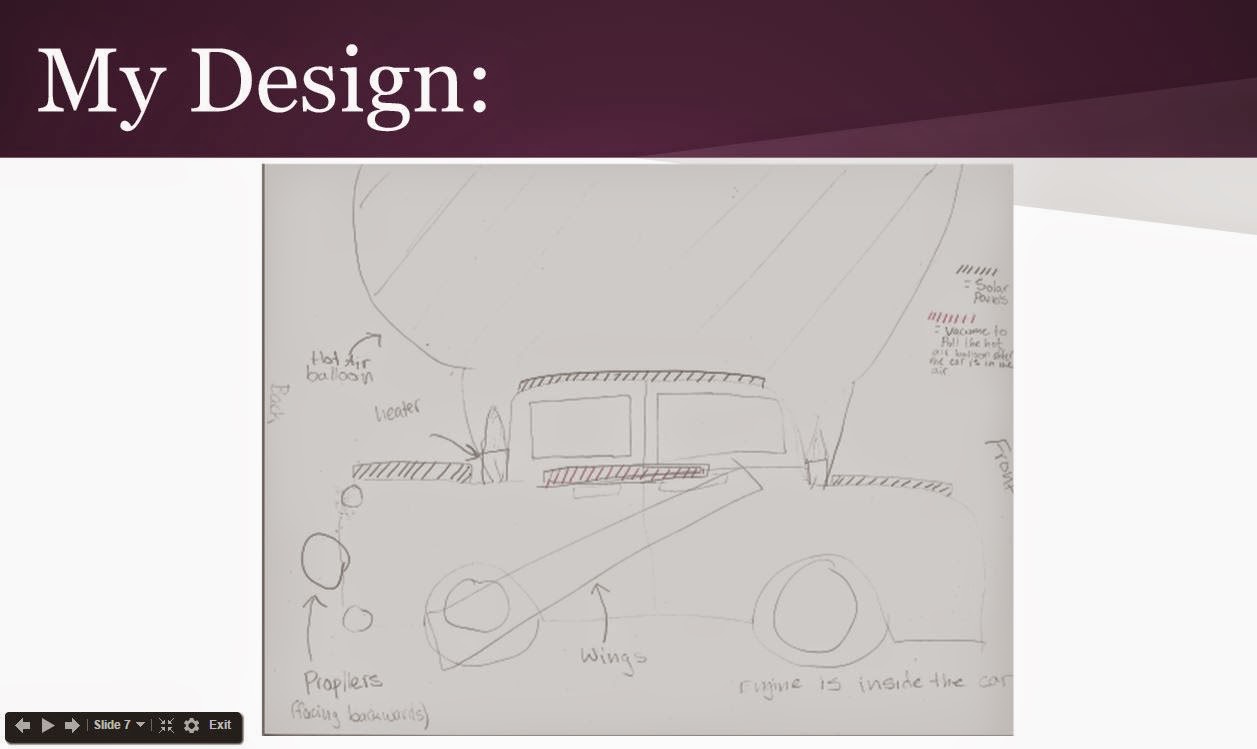
Proposals ranged from building a perpetual motion machine to designing a technology for artificial photosynthesis to performing a dissection to building a piezoelectric generator to designing a vaccination method that doesn't require needles to researching the changes in animals driven by domestication to designing an eco-friendly flying car to researching the benefits and current challenges with Deep Brain Stimulation to designing a test strip to identify bioaccumulated mercury in fish you're about to eat to researching the evolution of human speech. Seriously. 

A few key bits to the proposal:
  • The main focus of the proposal is why this project  is awesome and why it matters
  • Because it's science-focused, I'm relying on the NGSS to define "science." The kiddos had to identify both the science and engineering practices, and the science core concepts that would be addressed by the project (this tie to standards also hugely helped justify the project to my admin).
  • Each kid also had to write two rubric criteria for themselves, defining not meeting, meeting, and exceeding expectations for those criteria.
4) Moving forward with the projects

For the next 5 weeks, my 7th graders spent their 45-minute science period each Friday working on their Science Innovation Time projects.


Many kids, honestly, were also working on research-heavy projects that - while quite interesting! - don't make for as engaging pictures.  :-)

Following each of those Fridays, my kiddos also wrote a blog post to track their progress and learning. They also left feedback for at least three peers, asking questions or giving suggestions to help make their classmates' projects even more awesome. Those blogs are currently in walled-garden, but here are a couple screenshots... Again, I borrowed the blog prompts heavily from the fab Kevin Brookhouser. Jump in line to buy his book!

Blog Prompts:


3 Blog Samples:


5) Final Presentations

Finally, now after winter break, my students have given their final presentations! Again with the emphasis... these aren't big formal presentations, but rather just letting their classmates know what they learned, what their challenges and successes were, and whether they'll continue this project into the next "round" of S.I.T. or start a new project.

I have been *so* impressed with my students' presentations, and from the questions they asked each other after each presentation!


One of the most fantastic bits has been how well my students have confidently announced that their projects *failed* but that they still learned a lot and were able to overcome many challenges!

Fantastic outcomes:

  • Great science content improvements
  • Skill improvements from reliable researching to engineering
  • Self-monitoring via the blogs
  • Strong, confident presentation
  • Comfort with failure of the original plan, and seeing the success in the "pivot"!


6) Next Steps

Next week, before we start our new "official" science unit (genetics!) and our new round of S.I.T. proposals, I've got an idea for a wrap-up activity... I've made 5 sets of notecards with the "titles" for each project, and I'm going to have the kids sort the notecards into "types" of projects. I want to use this sorting activity for the kids to gather and analyze some data about the proportions of different types of projects, and to look for any types of projects that might be missing... My hope is that this will help kids expand their potential ideas, rather than my fear that ideas will narrow by latching onto only the most successful ideas from this round.

We shall see how that goes!

--------------------------------------------------

One student's final project: a full-scale horse prosthetic prototype!